

The Myth That’s Keeping Your Content Calendar Empty
Content marketing sounds completely reasonable on paper: post fresh content on every platform. Done.
But when it comes down to the reality of it, this process is exhausting. For most business owners running a service-based business, it’s not sustainable for more than two weeks before the whole plan quietly collapses.
One of the main problems we see with our clients is the feeling that absolutely everything needs to be fresh and brand new. You can’t ever repeat yourself. Each post needs to do something different.
The reality is that you should be repeating yourself. A lot. So much that you find your own content annoying. But here’s the key secret we have to teach people: your audience won’t find it repetitive, boring, or annoying. They’re not seeing it from the angle you are.
This is exactly why we teach a simple, repeatable content system. The benefits are two-fold: you’ll spend less time, energy, and frustration, and your audience will get a crystal clear picture of what you do and why they should choose you.
Let’s look at how you can turn a single, solid piece of content built on a clear message into fuel for your entire week of marketing.
Why Repurposing Works (and Why Most People Do It Wrong)
There’s a slight, but important, difference between repurposing and recycling content. When you recycle content, you’re typically taking a single idea and pushing it out across multiple platforms without changing much. The blog post becomes the social post becomes the newsletter.
Duplication isn’t the goal, though.
When done well, repurposing takes the core idea from one piece of content and translates it for different formats and contexts, so each piece serves its own purpose while reinforcing the same message. Your blog post does one job. Your newsletter does another. Your social content does a third. Together, they move the same person further along in understanding what you do and why it matters.
This is the difference between scattered content and a content ecosystem: individual pieces that work together as a system.
The reason most business owners struggle with it isn’t effort. It’s that they don’t have a clear enough message underneath the content to make repurposing feel natural. When your foundational messaging is solid, a single idea branches out almost automatically. Without it, every piece of content feels like starting from scratch because, in a sense, you are.
The Content Hierarchy: How the Pieces Connect
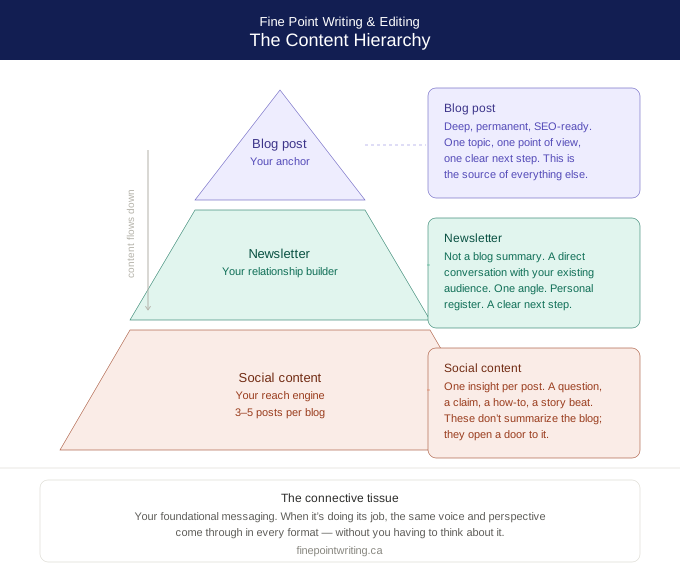
Think of your ongoing organic content as a pyramid, with your cornerstone content at the top and shorter, sharper pieces flowing down from it.
Here’s a very simple flow for many businesses:
1. The blog post (your anchor)
This is your most complete, most permanent piece of content. A well-written blog post does double duty: it lives on your website as an SEO asset (for search and AI) and serves as the source material everything else gets built from. It should go deep on one topic, include a clear point of view, and point toward a specific next step for the reader.
2. The newsletter (your relationship builder)
Your newsletter isn’t a summary of your blog; it’s a conversation about the same topic with your existing audience, but written in a more personal register. Pull one specific angle from the blog post and write to it directly, making sure that your audience will connect instantly with that insight. Link back to the post if the reader wants to go deeper, but also give them an instant next step if they’re ready to solve the problem (ideally, with you!)
3. Social content (your reach engine)
Social posts distill one bite-sized insight at a time. From a single blog post, you can pull at least three to five distinct ideas, each worth its own post. It might be a question, a counterintuitive claim, a moment from a client story, or a short how-to. These don’t summarize the blog; they open a door to it (and to your business).
The connective tissue between all of these is your core message. If your foundational messaging is doing its job, the same voice and perspective come through in every format without you having to think about it.
A Week of Marketing from One Piece of Content: What It Looks Like in Practice
Here’s a concrete walkthrough. Say you’re a business coach, and you’ve written a blog post titled “Why Your Clients Keep Ghosting After Discovery Calls.”
The post covers the real reason people don’t move forward after a great conversation (usually unclear next steps or mismatched expectations), and it ends with a call to action to book a consultation.
Here’s how the rest of the week unfolds:
- Monday: Publish the blog post. Also share it on LinkedIn as an article, and send it out as a two-sentence post that serves as a hook: “If your discovery calls feel great but rarely convert, the problem usually isn’t your offer—it’s what happens after the call.”
- Tuesday: Post a single-question social post: “What’s the one thing you wish you’d said differently in your last sales conversation?” Think of this as a conversation starter, not a sale or promotion.
- Wednesday: Send your newsletter. Write a short, personal version of the main insight, referencing a situation that prompted you to think about it. Link to the post, but also link to a more immediate solution you offer, whether that’s a product, service, lead magnet, or resource.
- Thursday: Share a short how-to post with two or three specific things to send a prospect after a discovery call. Make it practical and immediately useful.
- Friday: Post a client-adjacent story. Something short that illustrates what changes when someone tightens up this part of their process. No names needed; the situation does the work.
If you’re using our Lead Flow Framework system, drafting all these marketing materials should take approximately 20 minutes. Yes. Twenty minutes. You read that right.
This is exactly the kind of system Lean Marketing Lab members build inside the program. Each week, the goal is to create a complete set of marketing assets from a single starting point.
“But AI content is gross, Danielle!”
Agreed! It can be. But if you’re using the Lead Flow Framework, it eliminates about 90% of the “gross” factor of AI. Let’s look at how.
Where AI Fits In (and Where It Doesn’t)
AI makes the mechanical parts of repurposing faster. Given a blog post and clear instructions, it can draft newsletter copy, generate social post variations, and suggest different angles you might not have thought of on your own.
What it cannot do is decide what matters. It can’t choose which insight from your blog post is most likely to stop someone mid-scroll on a Wednesday afternoon. It can’t judge whether a story is specific enough to feel real or vague enough to feel generic. And it can’t make the call on tone and feel.
That judgment is yours. It comes from knowing your audience, knowing your message, and knowing what you’re actually trying to accomplish with each piece.
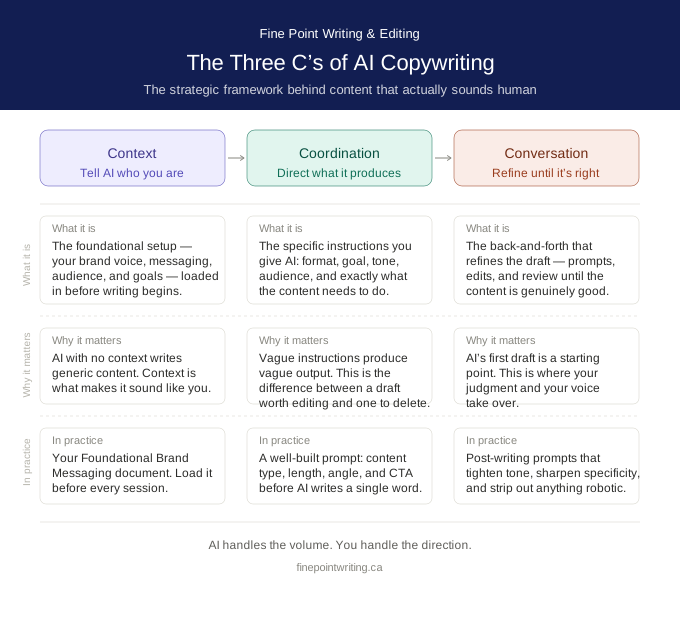
The Three C’s of AI Copywriting framework we use in the Lab puts it this way: context tells AI who you are, coordination directs what it produces, and conversation refines until it’s right. AI handles the volume, but you handle the direction.
Used in the right order, the combination is genuinely efficient. Used without a strategy and the right foundational pieces underneath it, you get faster content that still doesn’t connect.
How the Lead Flow Framework Makes This Repeatable
The reason this process tends to break down for most business owners isn’t capability. It’s that each week, they’re making the same decisions from scratch: what to write about, who it’s for, what the point is, where it should lead.
A proper content system removes most of those decisions by making them in advance. When you know your content pillars, your audience’s real concerns, and the next step you want readers to take, each new piece of content has a built-in brief. You’re filling in specifics, not inventing a direction.
That’s the core of the Lead Flow Framework: a strategic, interconnected approach to content marketing that moves people from first discovering you to deciding to work with you. The framework doesn’t make content creation automatic, but it makes it significantly faster and far less likely to produce something that leads nowhere.
The result is a content presence that actually compounds. The blog post you write today feeds this week’s newsletter, feeds next month’s social content, and keeps earning search traffic six months from now. That’s the system that successful businesses are using.
Ready to Stop Starting From Scratch Every Week?
If you’ve been treating every piece of content as a separate project, repurposing isn’t just a time-saving tactic; it’s the thing that makes consistent marketing possible without turning it into a second job.
The process above works, but it works even better when it’s built on a clear message foundation and a repeatable framework, which is exactly what Lean Marketing Lab is built to give you. Members build a complete set of marketing assets each week, with live coaching and real-time feedback, so the system actually gets used.
If you’re ready to build a content system that compounds instead of one you have to restart every week, join us in the Lab.