
If Your Website Traffic Patterns Are Changing, You’re Not Alone
People used to reach out to us all the time after hearing about this magical thing called “SEO.” Today, we’re having people reach out about something related, but also different: AI search. The reality is that search engine results have changed shape as a result of AI, and the strategy that used to work is only doing half the job it used to.
You might be following textbook SEO requirements perfectly, and your website might even be ranking first, but your customers aren’t clicking on your link because an AI-generated summary answered the question right there on the results page. Rather than visit your website, the customer closed the browser tab, satisfied with their summary answer.
So, your ranking held, but your traffic didn’t. If that sounds like something you’ve noticed in your own analytics over the past few months, you’re not imagining it, and you’re not alone.
We’ve covered whether AI-generated content hurts your SEO (it doesn’t; thin content does), and now we need to talk about something bigger: how AI search actually works and what that means for your content.
What’s Actually Different About Search Right Now
For most of the last two decades, search worked the same way. You typed a question, Google (or your search engine of choice) handed you ten blue links ranked by relevance, and you clicked one. Whoever ranked highest generally won those clicks, sending a wave of traffic to that website.
That system still exists, but the full page is no longer the focus.
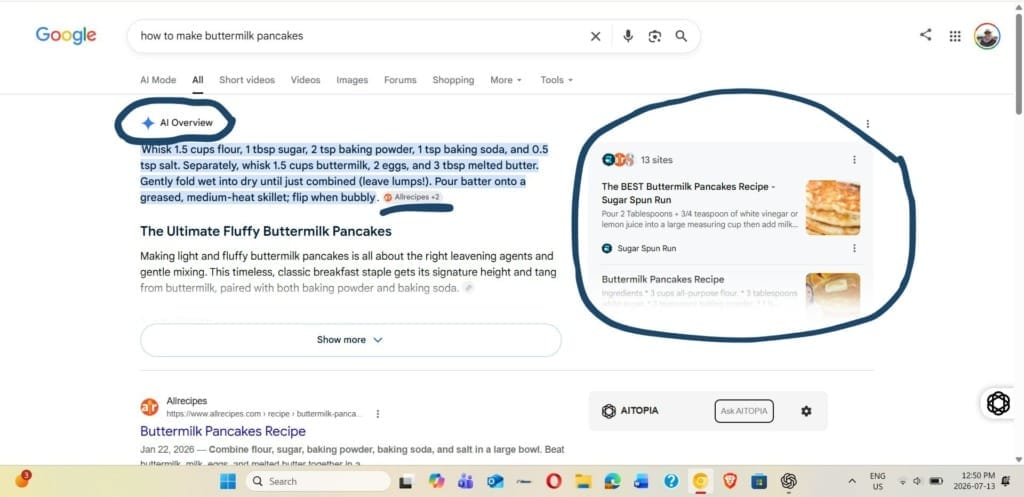
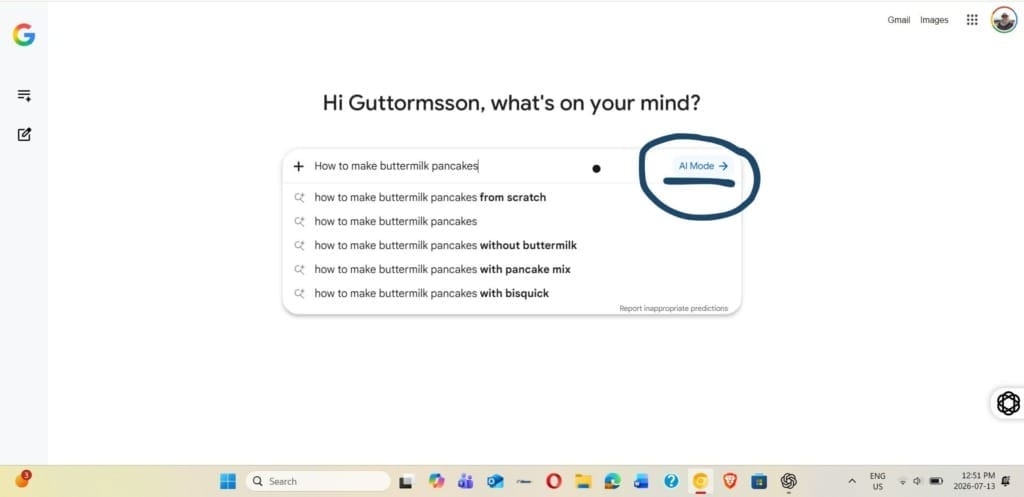
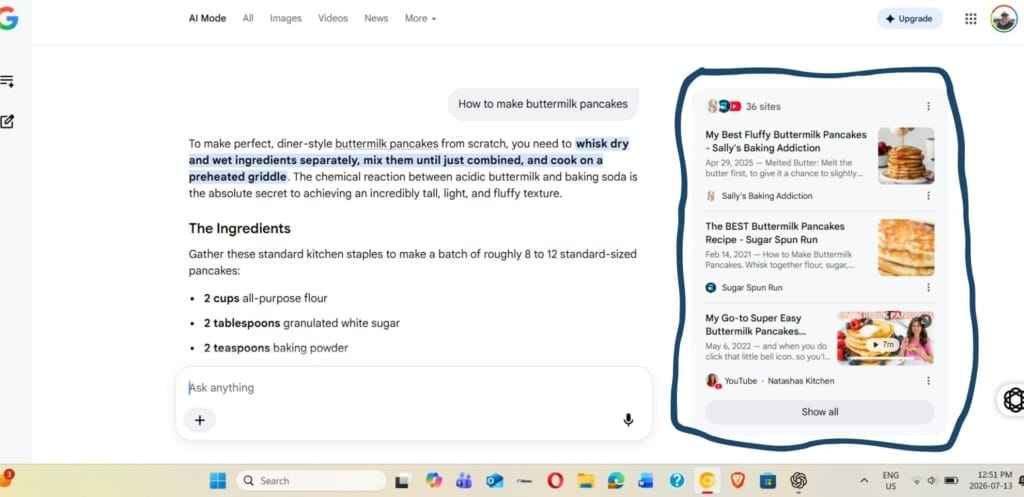
Google now layers AI-generated answers directly into results through two features: AI Overviews, which show up inline above the traditional listings, and AI Mode, a fully separate, conversational search experience Google expanded significantly at its May 2026 developer conference. Instead of returning a ranked list, AI Mode has a conversation with the user, synthesizes an answer from multiple sources behind the scenes, and often shows no traditional links at all.
AI Overview Sample – Buttermilk Pancake Search
AI Mode Sample – Buttermilk Pancake Search
Google isn’t the only company doing this. ChatGPT, Perplexity, Claude, Microsoft’s Copilot, and other AI platforms are all doing some version of the same thing:
- Step 1: Take a question.
- Step 2: Run several searches behind-the-scenes to cover the angles a single query would miss.
- Step 3: Pull content from a handful of web pages.
- Step 4: Generate one synthesized answer instead of providing a list for the user to sort through themselves.
This process matters because it explains your shift in results. These tools aren’t picking a single winner and sending everyone there. They’re reading several sources, extracting the specific passages that answer the question well, and weaving those pieces into one response.
So what does this mean for you?
It means your content doesn’t need to win the whole page anymore. Instead, it needs to contain the exact passage worth extracting. Let’s look at why that is and how to do it.
Where AI Search Results Come From and Why Ranking First Doesn’t Guarantee Getting Found
A page that ranks in Google’s top ten has a 37.1% chance of also being cited in an AI-generated answer for that same query, according to a 2026 Ahrefs study on AI search citations. They also found that content ranking between 11 and 100 shows up in citations 26.2% of the time, while content that didn’t even make the top 100 results showed up in citations 36.7% of the time.
This means that ranking well does not guarantee you’ll be cited in the AI summary.
In terms of your SEO strategy, it means that traditional SEO still matters because every AI search tool still relies on the same fundamentals that have always mattered:
- Quality, trustworthy content
- Technical accessibility
- Readability
- Indexing
- Established authority
None of that gets to skip the line. But once your page clears that bar, a second filter kicks in, and it has nothing to do with your position on the page. It’s about whether the AI can lift a clean, self-contained, accurate passage out of your content and use it.
That second filter is the one most business owners haven’t caught up to yet.
What Part of Your Content Actually Gets Extracted and Cited
If you want to understand what these tools are looking for, it helps to think less like a marketer trying to rank and more like an editor cutting out the fluff to make a clear point.
A good quote stands on its own. It doesn’t require three paragraphs of setup to make sense, and it says something specific rather than something generic. That’s what AI systems are hunting for inside your content: a clearly stated answer, close to the question that would prompt it, that doesn’t depend on reading the whole page to understand.
This changes a few things about how content should be built.
Answer the question directly, early, and in plain language. If a section is titled “How long does foundational messaging take to build?” the paragraph underneath it should answer that question in the first sentence or two, not work up to it. Save the nuance and the caveats for after the direct answer, not before it.
Structure content so a passage can stand alone. Write headings that mirror how people actually ask questions, paired with short, focused sections. Adding in specific claims with real numbers attached will also make a page easier to extract information from. A wall of undifferentiated text, however well-written, gives these systems very little to grab onto.
Specificity is still your biggest advantage, and it’s a bigger one than it used to be. Generic, forgettable content was already a weak strategy before AI search rose to the forefront. Now it’s a page that gets skipped entirely, because there’s nothing distinct enough inside it to extract. This is the same argument we made in our last post: the businesses that will hold up here are the ones whose content reflects real experience, specific numbers, and a genuine point of view, not the ones producing the most pages.
E-E-A-T hasn’t gone anywhere. If anything, it matters more. Google has been explicit that the same signals of experience, expertise, authoritativeness, and trustworthiness that drive traditional rankings also determine what gets surfaced in AI features. There’s no secret AI optimization checklist to chase; it’s the same foundation, applied with more precision.
What This Means for How You Measure Success
When search methods shift, your measurement of success needs to shift as well. Your rankings might be holding perfectly steady while your click-through traffic quietly dies out. This is because the AI Overview absorbs the click before anyone sees your listing. But that’s not necessarily a penalty if you know what to measure.
The practical takeaway isn’t to panic about traffic numbers; it’s to widen what you’re paying attention to. Your search console data will look fine, but your website analytics won’t, and that’s not a bad thing. Being the source an AI system cites, even when nobody clicks, still builds the kind of visibility and trust that shows up later, when your ideal client is ready to act.
The real worry is losing clicks entirely because your content can’t answer the questions your audience is asking.
Where to Actually Put Your Energy in Terms of Content and SEO Strategy
The good news is that none of this calls for a new content strategy built from scratch. What’s more important is focusing on the fundamentals with more precision and detail than most businesses are used to using in their content.
Keep publishing content built on real expertise and real specificity, structured in a way that allows the reader (or retrieval system) to find the direct answer fast. Keep building the kind of authority that gets you cited as a trusted source in the first place, which was always the actual goal of good content, long before AI search existed. And keep the foundational work in place that makes all of this possible: a clear sense of what your business actually knows that nobody else can say the same way.
That foundation is exactly what we build with clients during our Foundational Brand Messaging Masterclass, and it’s the starting point for everything we teach inside the Lean Marketing Lab.
And remember, just because the tools measuring your content keep changing, the type of content worth citing stays the same.